Guoyin Chen Solar physics

Guoyin Chen

陈国银

The Sun's magnetic field is written in polarised light. I build the diagnostics that read it: inversion codes, neural solvers, field extrapolations. Then I test what we think the solar atmosphere is doing.

PhD student, School of Astronomy and Space Science, Nanjing University Guest researcher, Rosseland Centre for Solar Physics, University of Oslo gychen@smail.nju.edu.cn
Guoyin Chen in profile at sunset, looking out over a city
Plate IPortrait
Guoyin Chen, in profile at the end of the day.
01Research

Reading the magnetic field

Five threads, one question asked at five heights: what is the field doing in the solar atmosphere, and how would we know?

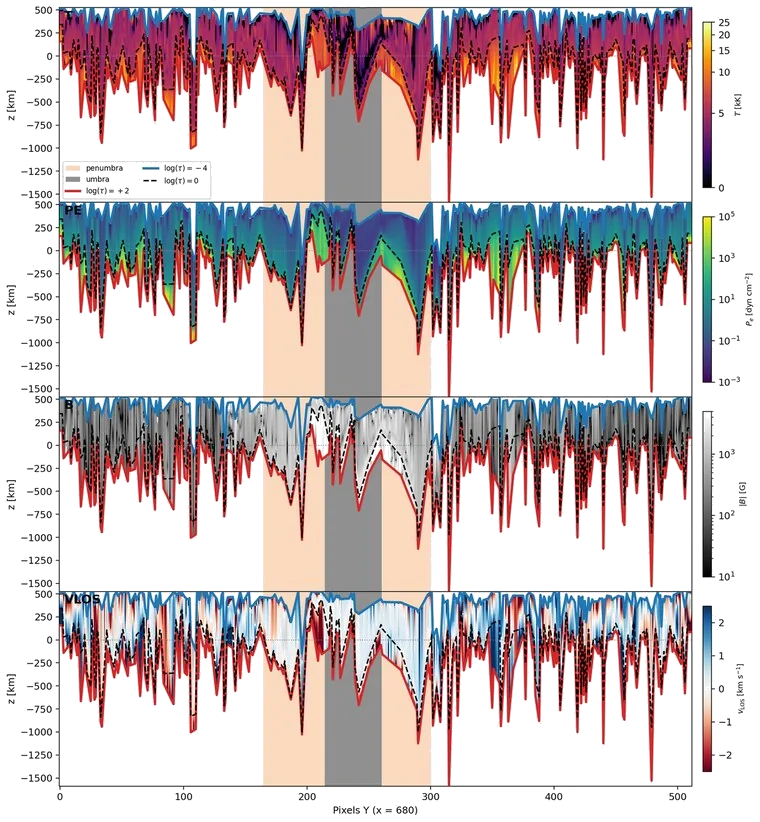
Four stacked panels of the inverted atmosphere against height: temperature, electron pressure, magnetic field strength and line-of-sight velocity, with the umbra and penumbra bands marked.
Plate II The atmosphere the inversion returns, cut along one slit: temperature, electron pressure, field strength and line-of-sight velocity against height, with the umbra and penumbra marked. From Chen et al. 2026, A&A 710, A227.
01

Spectropolarimetric inversion

A Stokes profile is a fingerprint with the field, the temperature and the velocity tangled together. I write inversion codes that untangle them: Milne–Eddington solved in batch on a GPU, node-based nonlinear least squares, and now physics-informed networks that return a whole atmosphere in a single pass.

02

Learning the inverse problem

The inverse problem is expensive because it is iterative. A network trained on radiative-transfer solutions does not replace the physics; it makes the physics affordable, returning a full field of view without iterating per pixel.

03

Magnetic-field extrapolation

The photosphere supplies a boundary condition and the corona supplies the consequences. Extrapolation lifts a measured surface field into the volume above it, force-free in the classical formulation and now learned with a physics-reinforced GAN.

04

Data-constrained MHD

A simulation is only useful if it can be observed. I run MHD models of the global corona constrained by measured fields, and synthesise what an instrument would see, so that model and observation can be compared in the same units.

05

Coronal seismology

Loops oscillate, and the period carries density, field strength and geometry inside it. Spatial seismology turns that oscillation back into the parameters responsible for it: a measurement made of time instead of light.

Plate III Two networks
PI-squared-NN diagram: an encoder and a decoder exchange an eight-parameter atmosphere, while a Milne-Eddington forward model turns the network output back into Stokes spectra for the loss.

PI2NN. A physics-informed network trained cyclically: a Milne–Eddington forward model turns the network’s own output back into spectra, so the loss is measured in Stokes space rather than in parameter space. It returns a starting atmosphere; the classical inversion refines it.

SPOT network diagram: Stokes I, Q, U and V enter an embedding block, pass through two Fourier neural-operator blocks and four transformer blocks, then a depth decoder and eight parameter heads.

SPOT. An operator transformer: Stokes IQUV in, two Fourier neural-operator blocks, four transformer blocks, a depth decoder, and eight parameter heads out. One forward pass replaces the per-pixel iteration.

Chen et al. 2026, A&A 710, A227

02Publications

Selected papers

Five of 11, chosen for what they show about the method. The full record, 2021–2026 and 4 as first author, carries abstracts and BibTeX.

Plate IVCoronal loops

Schematic, not an observation: a family of loops standing on the limb, drawn from the geometry an extrapolated field produces. The same shape is what PF2nlfff has to recover from a photospheric boundary.

03Software

Instruments

The codes behind the papers, and the small tools that keep the literature readable while the papers get written.

SPOT Inversion · Python

PyTorch library for Stokes IQUV spectral synthesis and inversion, with a pretrained neural-operator solver.

v1.2.0PyTorchSynthesis
CuSP Inversion · CUDA

GPU-batched Milne–Eddington inversion of solar Stokes profiles with gradient-bias annealing and a physics-informed network.

JupyterBatched solve
PF2nlfff Extrapolation · Python

Physics-reinforced GAN that extrapolates a photospheric boundary into a 3D nonlinear force-free magnetic field.

v2.0.0MITGAN
arxiv-checkup Tooling · agent skill

Agent skill that watches chosen arXiv categories and files relevant new papers into a three-level Zotero tree.

v0.1.1MITZotero
zotnote Tooling · agent skill

Agent skill that turns Zotero PDFs into illustrated Markdown reading notes mirrored into an Obsidian vault.

v0.6.0MITObsidian
dsh-overleaf Tooling · editor

Overleaf workbench embedded as a fourth session tab in DeepSeek Harness Web, with selection quoting and caret insertion.

v1.0.1MITJavaScript

Everything else, agent skills and editor plugins, lives on GitHub.

04About

Between the observation and the model

I work between the observation and the model. The instrument measures polarisation; the atmosphere answers with a magnetic field, a temperature and a line-of-sight velocity. Everything I do is an attempt to get from the first to the second without losing the physics on the way.

I am a direct-entry PhD student in astronomy at Nanjing University, where the coronal-seismology work began, and a guest researcher at the Rosseland Centre for Solar Physics in Oslo, where I work on inversion, extrapolation and radiation synthesis for data-constrained MHD models of the corona.

The codes are public, SPOT and CuSP for inversion and PF2nlfff for extrapolation, because a diagnostic is only as reproducible as the code that produces it and because the fastest way to be corrected is to publish the tool.